

OpenAI Ads Manager Update: What's Changed Since Our Initial ChatGPT Ads Beta Test
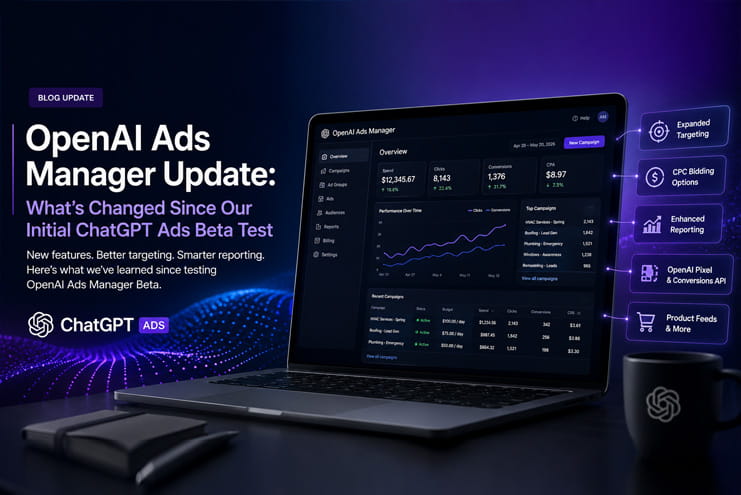
Editor's Note: In early 2026, AdMax Local was among the first agencies to test OpenAI Ads Manager Beta and share our findings publicly. Since then, OpenAI has introduced new targeting capabilities, CPC bidding, product feeds, conversion tracking enhancements, and expanded reporting. This article serves as an update to our original beta analysis and highlights the most significant changes we've observed.
When we first published our analysis of OpenAI Ads Manager Beta, one question dominated the conversation: Are ChatGPT Ads a legitimate advertising channel, or simply another marketing experiment? A month later, the answer is becoming much clearer.
ChatGPT advertising has evolved rapidly. OpenAI has introduced new targeting capabilities, expanded reporting, enhanced conversion tracking, product feed integrations, and improved campaign management tools. What started as an emerging AI advertising platform is beginning to look more like a channel that businesses should actively monitor and test.
For SMBs, franchise organizations, and white-label marketing partners, the opportunity extends beyond placing ads inside ChatGPT. It is about understanding how AI search is changing customer behavior and how businesses can position themselves for visibility in the next generation of search experiences.
Our AdMax Local account teams continue testing, monitoring, and evaluating the OpenAI Ads Manager platform. Here is what we've learned since our initial ChatGPT advertising beta review.
The Biggest Update in ChatGPT Advertising Isn't the Ads
It's the conversations. Traditional advertising platforms generally capture existing intent. Google Ads captures intent when someone searches for "roof replacement near me." Meta captures intent based on demographics, interests, and behavior. ChatGPT advertising operates differently. The platform can influence intent before a user reaches the buying stage.
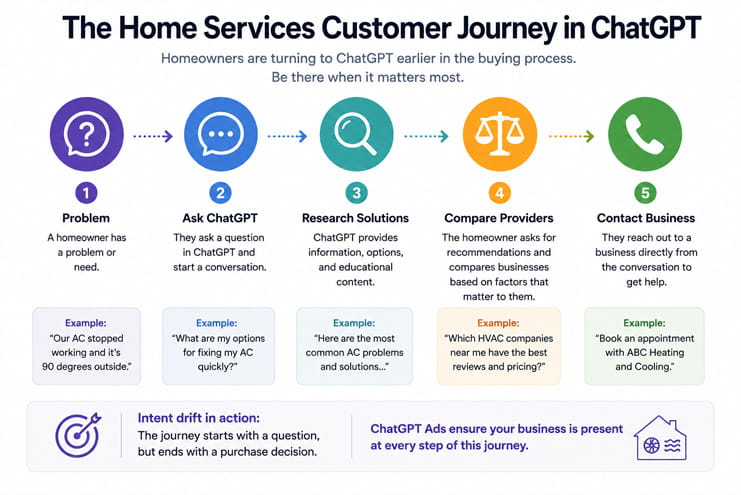
Recent industry research suggests nearly half of users who ultimately engage with a commercial recommendation in ChatGPT began with a non-commercial question. The conversation itself helped shape the purchasing journey. Researchers have started referring to this as "intent drift."
Consider this example:
A homeowner starts by asking:
"Why is my air conditioner making a rattling noise?"
Twenty messages later they're comparing HVAC replacement companies and requesting cost estimates. That entire journey occurs within a single conversation. Traditional search engines often capture the final step. ChatGPT participates in the entire decision-making process. And that's what makes ChatGPT Ads different from every major advertising platform that came before it.
OpenAI Ads Manager Has Matured Faster Than Expected
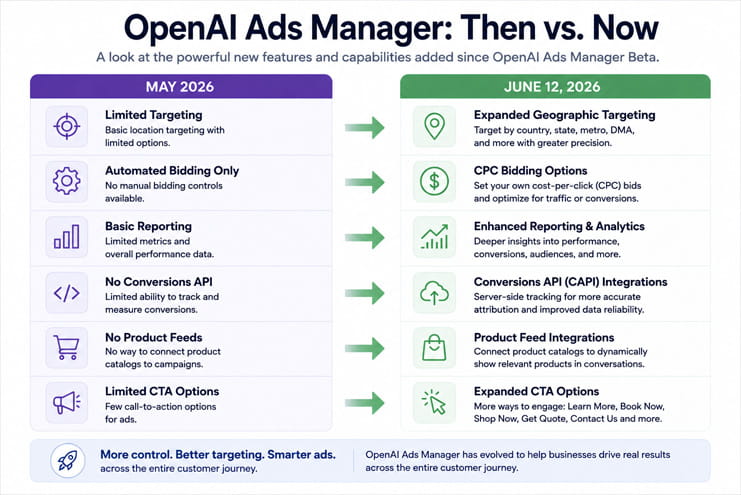
When AdMax Local first gained access to OpenAI Ads Manager Beta, campaign controls were relatively basic. Today, the platform offers significantly more sophistication.
Recent updates to OpenAI Ads Manager include several improvements that move the platform closer to what advertisers expect from mature advertising channels such as Google Ads and Meta Ads.
Notable enhancements include:
Cost-per-click (CPC) bidding controls, giving advertisers more flexibility to optimize toward traffic goals rather than relying exclusively on automated delivery.
Daily and lifetime budget management, allowing businesses to better control spend and test campaigns with smaller budgets.
Expanded geographic targeting, including the ability to target specific countries, states, metropolitan areas, and designated market areas (DMAs), making the platform more viable for franchise organizations, regional brands, and multi-location businesses.
Conversion-focused campaign objectives, enabling advertisers to optimize campaigns around lead generation and website actions rather than simply impressions or clicks.
OpenAI Pixel implementation, providing greater visibility into website activity after users engage with ChatGPT Ads.
Conversions API (CAPI) integrations, helping advertisers improve attribution accuracy and reduce signal loss caused by browser restrictions and privacy changes.
Product feed integrations, allowing ecommerce advertisers to connect product catalogs directly to campaigns and dynamically serve relevant products based on user conversations and intent signals.
Enhanced reporting and campaign analytics, offering deeper visibility into clicks, conversions, audience engagement, and campaign performance.
Expanded call-to-action options, including Learn More, Book Now, Shop Now, Get Quote, and Contact Us, depending on campaign objectives.
For franchise systems and local businesses, the geographic targeting improvements may be one of the most significant developments. Earlier versions of ChatGPT advertising felt primarily suited for national advertisers. Today's capabilities allow brands to align campaigns more closely with specific territories, markets, and service areas.
The addition of CPC bidding is also noteworthy because it gives advertisers a familiar buying model for testing ChatGPT Ads alongside existing Google Ads and Microsoft Ads campaigns, making performance comparisons much easier.
And while product feeds may not be relevant for every advertiser, they represent an important step forward for retailers and ecommerce brands. Like Google Shopping and Meta Catalog Ads, product feeds help bridge the gap between conversational discovery and product-focused advertising, allowing users to move from asking questions to evaluating products within the same journey.
Why Home Services Companies Are Winning with ChatGPT Advertising
One of the strongest cases we've observed involves home service businesses. The reason is simple. Consumers ask questions before making expensive decisions.
Lots of questions.
Questions like:
How much does a roof replacement cost?
Should I repair or replace my HVAC system?
What should I ask before hiring a plumber?
How long should a water heater last?
What are signs my foundation needs repair?
These conversations are happening inside ChatGPT every day.
Unlike traditional search advertising, where businesses compete for a keyword, ChatGPT advertising allows brands to appear within the broader research process.
That creates opportunities for:
HVAC companies
Roofing contractors
Plumbing businesses
Remodelers
Home improvement franchises
Restoration companies
The customer journey often starts long before a search for a local provider. ChatGPT Ads allow businesses to participate earlier in that journey. And that's exactly why home services may become one of the earliest categories to see meaningful success from ChatGPT advertising.
The Competitive Intelligence Opportunity Most Advertisers Are Missing
Every major advertising platform eventually becomes a source of market intelligence. Google gave marketers keyword data. Meta provided audience insights. ChatGPT may become the first major platform that reveals conversational intent at scale. Think about what that means.
Businesses can begin identifying:
Questions prospects ask before buying
Objections that delay purchases
Competitor brands being mentioned
Research paths leading to conversions
Topics influencing purchase decisions
For franchise organizations and multi-location brands, this information could become just as valuable as advertising itself.
The future value of ChatGPT Ads may not simply be lead generation. It may be the customer intelligence generated from millions of conversations.
What We're Learning About High-Performing ChatGPT Ads
One of the biggest surprises from early ChatGPT advertising campaigns is that traditional ad copy techniques don't always work.
The highest-performing ChatGPT Ads tend to be:
Helpful
Relevant
Contextual
Educational
Trustworthy
Not flashy.
Not gimmicky.
Not overloaded with promotional language.
Users enter ChatGPT seeking answers. The ad that contributes to solving the problem often wins. For businesses testing OpenAI Ads Manager, this means creative strategy matters.
The brands that position themselves as trusted experts may have an advantage over those relying on aggressive sales messaging. In many cases, the best ChatGPT Ads feel less like advertisements and more like useful recommendations.
What SMBs, Franchise Brands, and Agencies Should Do Right Now
We do not believe ChatGPT advertising should replace Google Ads, SEO, Meta Ads, or local marketing efforts.
Not even close.
But we do believe businesses should begin preparing for a future where AI search becomes a larger part of the customer journey.
Here are four recommendations:
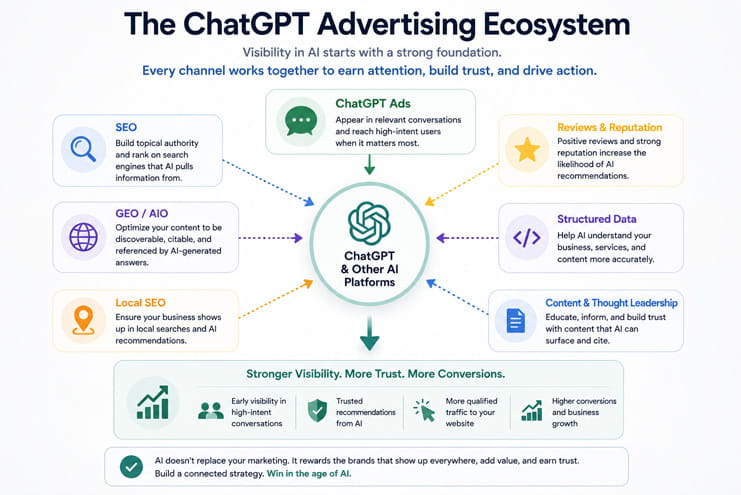
1. Build Visibility in AI Search
The brands showing up organically in AI-generated recommendations are often the same brands with strong authority signals.
Focus on:
High-quality content
Strong reviews
Local SEO
Structured data
Consistent business information
2. Strengthen Local SEO Foundations
Many AI systems rely on information that originates from local search ecosystems. Google Business Profile optimization remains critical. So do reviews, citations, and location pages.
3. Improve Tracking and Attribution
Before testing ChatGPT Ads, ensure your analytics foundation is solid.
That includes:
Conversion tracking
CRM integration
Call tracking
Offline conversion reporting
4. Start Testing Early
This is still an emerging advertising platform. Businesses that learn early often gain advantages as adoption increases. Small-scale testing today can provide valuable insights tomorrow.
The Future of ChatGPT Advertising and AI Search
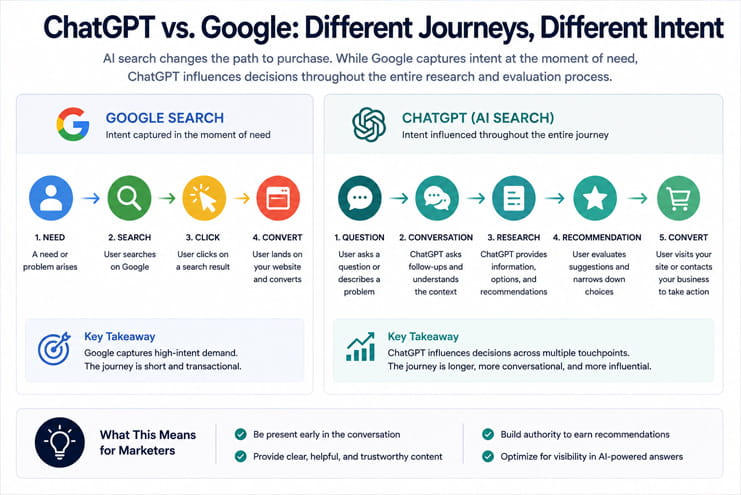
The biggest mistake marketers can make is assuming ChatGPT Ads are simply another version of Google Ads.
They are not.
Google captures intent.
ChatGPT helps shape intent.
That distinction matters.
OpenAI Ads Manager is still in its early stages, but the pace of development has been remarkable. New capabilities continue to appear, reporting continues to improve, and advertiser interest continues to grow.
Will ChatGPT advertising replace Google Ads?
Probably not.
Will it become a meaningful part of the digital marketing landscape?
Increasingly, that appears likely.
For businesses that want to stay ahead of changing consumer behavior, now is the time to pay attention.
Because the future of digital marketing may not be defined solely by search engines.
It may be defined by conversations.
And businesses that learn how to participate in those conversations early may gain a significant competitive advantage.
Frequently Asked Questions About ChatGPT Advertising
What are ChatGPT Ads?
ChatGPT Ads are advertisements delivered within OpenAI's ChatGPT platform. They are designed to appear within relevant conversations and help businesses connect with users during the research and decision-making process.
What is OpenAI Ads Manager?
OpenAI Ads Manager is an advertising platform that allows businesses to create, manage, target, and measure ChatGPT advertising campaigns.
Can local businesses advertise on ChatGPT?
Yes. Recent updates to OpenAI Ads Manager have improved geographic targeting, making the platform more relevant for local businesses, franchise organizations, and regional service providers.
Are ChatGPT Ads better than Google Ads?
Not necessarily. Google Ads and ChatGPT Ads serve different purposes. Google captures existing search intent, while ChatGPT can influence purchasing decisions earlier in the customer journey.
Should SMBs test ChatGPT advertising now?
For many businesses, the answer is yes. Small-scale testing can provide valuable insights while competition remains relatively limited compared to more established advertising channels.
How can businesses prepare for AI search?
Businesses should focus on strong SEO fundamentals, local search visibility, online reviews, structured data, high-quality content, and accurate business information across the web.
Posted On : 15-06-2021
Author : Patrick Dean Hodgson
Latest Blogs
Archives
No archives